Google Business Profile for Restaurants 2026: 7 Ranking Factors
32% of local rank comes from your Google profile. 7 real factors that decide whether your restaurant shows up on the map. Complete guide.
Change history (2)
- — H3 sweep matching SR sibling (bezsajta-blog skill 2026-05-11 rule 27): added H3 sub-structure to 7 content-dense H2 sections (impact, ranking factors, category, reviews, posts/photos, when GBP isn't enough, weekly maintenance).
- — First version — original data from our Wolt scrape across Belgrade/Niš/Kragujevac, BrightLocal LSRF 2026 + LCRS 2026 factors, direct-answer lede.
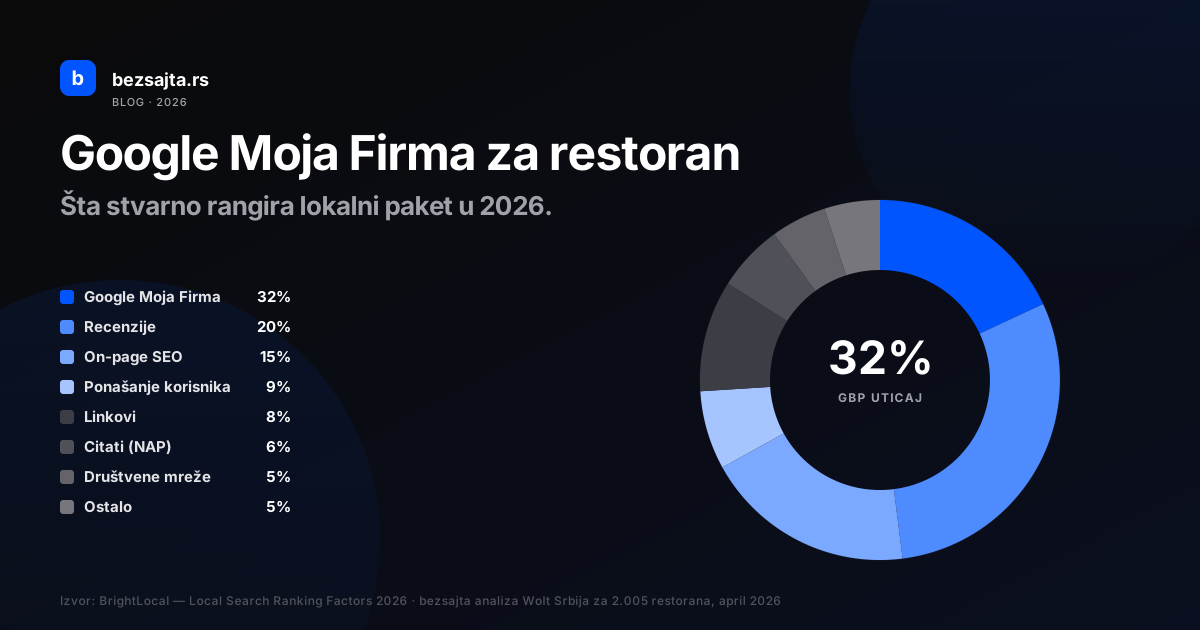
Your Google Business Profile carries 32% of the weight in local pack rankings — more than any other single factor, including your website. Reviews add another 20%. Together, that means more than half of your map visibility depends on 2 things Google gives you for free, and most owners leave them untouched for 12+ months (BrightLocal Local Search Ranking Factors, 2026).
97% of consumers read reviews before choosing a local business, and 41% do so “always” (BrightLocal Local Consumer Review Survey, 2026). Skip the map for “restaurant + your part of town” and those guests go to the competitor 200 meters away. That’s tables filled on a Friday at 8pm.
This article covers 7 concrete factors that move the needle in 2026. Each has a source and a Balkan example from Niš, Belgrade, or Kragujevac. To see how all this fits into one bundle, check what’s included in €59/month.
How much does Google Business Profile actually impact restaurant traffic?
Search mechanics — 55% of clicks go to the Map Pack before any organic result
In 2026, GBP is often more important than your website for the restaurant niche. Search mechanics explain why. Someone in Niš typing “restaurant near me” or “pizza city center” on a phone sees three map results first — the “local pack” — and only below that the standard website list. By Whitespark’s 2026 research, about 55% of users click one of those three local results before they even see the first organic link (Whitespark 2026 Local Search Ranking Factors, cited via BrightLocal).
Different algorithms — a flawless site doesn’t help if GBP sits half-filled
A second factor: the local pack and organic results use different algorithms. For a website, on-page SEO carries the most weight (33%) followed by links (24%). In the local pack, the Google Business Profile carries 32%, reviews 20%, and the website only 15% (BrightLocal LSRF, 2026). A flawless website and a half-filled GBP means your restaurant vanishes from the map.
Wolt vs. Google — review asymmetry in Niš and Belgrade
From our Wolt analysis: Niš has 229 active restaurants with 56,422 reviews total and an average rating of 9.1/10 (Wolt scrape, 2026-04). Belgrade: 1,651 restaurants and 496,209 reviews. Those are Wolt numbers. Many Balkan restaurants have 500+ Wolt reviews and fewer than 20 on their Google profile. That gap is a concrete opportunity covered in the reviews section.
What are the real ranking factors in Google’s restaurant map pack?
Google’s official three pillars — and what that means in practice
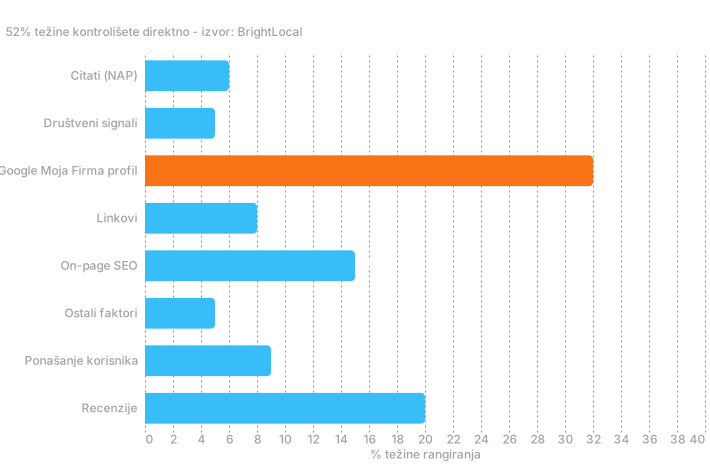
Google’s official documentation describes 3 pillars: relevance, distance, prominence (Google Business Profile Help — Improve Ranking). Industry research breaks those 3 buckets into 7 factors that carry almost the entire decision weight.
The seven real factors and their relative weight
What this means for budget — and how to spot a bad agency
Take this as a budgeting test. An agency quoting €400 for “SEO optimization” that never mentions GBP categorization, photos, or a review collection system is selling you 15% of the picture.
For context on how much a website costs in Serbia and where it fits, see our breakdown of 7 public Serbian agency price lists (How much a website costs in Serbia 2026).
Which category should you pick — and why is it the biggest owner mistake?
Why primary category is ranking factor #1
Primary category is the #1 ranking factor in Google local rankings in 2026. Not keywords in the business name, not review count. BrightLocal found businesses using 4+ secondary categories average a map rank of 5.9 — almost 5 places higher than those with only a primary (BrightLocal LSRF, 2026).
More specific beats “Serbian restaurant”
The most common owner mistake: picking “Serbian restaurant” as primary because it sounds authentic. That hurts ranking. Google Business Profile maps categories to specific search intents:
- “Pizza restaurant” as primary for a pizzeria — covers searches like “pizzeria”, “pizza near me”, “pizza delivery”
- “Barbecue restaurant” for a grill house — catches “grill”, “ćevapi”, “burger”
- “Grill restaurant” — similar logic
- “Restaurant” as a general fallback — wider reach but weaker match
- “Serbian restaurant” → use as a secondary, never primary
A Novi Sad pizzeria with primary “Serbian restaurant” + secondary “Pizza restaurant” dropped out of a tenth of “pizzeria Novi Sad” searches. Google’s index maps “pizza” most strongly to “Pizza restaurant” as primary.
The other mistake — too many secondary categories
More than 5 secondary categories triggers Google’s spam detection and rank drops fast. The sweet spot is 1 primary + 3–4 secondaries, all closely related.
How to check whether your category is set right
A practical check: in an incognito window, search “pizzeria + your city” and “restaurant + your city”. Appearing for the first but not the second means your primary is pizza-specific — that’s correct. Showing up for “restaurant” but not “pizzeria” is the inverse problem, and you’re losing category-specific searches.
How many reviews does a restaurant in Niš need to outrank competitors?
Freshness + consistency > absolute count
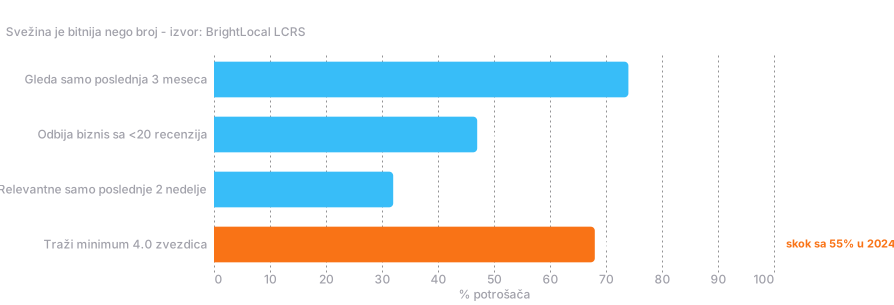
The answer isn’t a target number; it’s freshness and consistency. The 2026 Local Consumer Review Survey:
What that means for a Niš restaurant in practice
A kafana in Niš with 120 reviews and the most recent from October 2024 ranks below a competitor with 40 reviews, 15 of them from the last 30 days. Google treats a dead review pulse as a dead profile.
Wolt-Google asymmetry — where the opportunity is
From our database: Niš restaurants on Wolt average ~246 reviews per location (56,422 total / 229 restaurants). On Google, those same restaurants typically have 30–80. The gap exists because Wolt prompts the customer to rate inside the app; Google doesn’t trigger automatically. A realistic minimum to enter the top 5 in the Niš local pack: 40–60 Google reviews averaging 4.5+, collected in the first 90 days of operation.
Three tactics for accelerated collection
To collect them without pressuring guests:
- QR code on the bill or menu — scans direct to your Google review link (
search.google.com/local/writereview?placeid={PLACE_ID}) - Viber/WhatsApp message the day after the visit — not 2 months later, not a week later, but the next day. Conversion is 8–12x higher.
- Reply to every review within 48 hours. 80% of consumers say they’ll pick a business that replies to every review. 50% are turned off by businesses with generic replies like “Thanks for the rating”. Your reply needs to mention a specific detail from the comment.
Our WhatsApp reservation system sends a review request automatically the next day at 11am after a restaurant visit — without you having to track anything.
How often should you publish GBP Posts and add new photos?
Posts frequency — the weekly-reset rule
Most agencies say “post when you have something.” That’s wrong. Google treats GBP Posts as a weekly-reset signal: a post older than 7 days reads as an inactive profile, regardless of content. Minimum 1 post per week, ideally 2.
What to post when you don’t have news
- Daily/weekly special — “This week: veal soup 490 RSD”
- A dish photo from the kitchen — not a marketing render, an actual shot
- Event post — 72h before the event, with the date
- Question to guests — “What would you like on the Sunday menu?” — rare but engaging
- Holidays/local — Easter, slava, local festivals
Our social media automation bundle generates GBP Posts at the same time as Instagram + Facebook posts, so a single photo recycles across 3 channels.
Photos — owner vs. guest, and the right cadence
Photos are the other half of the signal. Google separates owner-uploaded photos from guest photos. Owner photos carry the weight of active profile management. Recommended cadence:
- First 30 days: 15–20 owner photos (exterior, interior, 5–8 dishes, team, logo, atmosphere)
- After that: 2–3 new ones per month
Add photos from the Google Maps app on your phone. EXIF data (GPS, timestamp) adds a verification layer that desktop uploads via the web interface strip out.
When Google Business Profile ISN’T enough — where’s the line?
GBP isn’t a fix-all. There are situations where profile optimization alone won’t carry you.
Four scenarios where the profile won’t solve the problem
-
Chains with 5+ locations. Google Business Profile Manager, Chain schema in JSON-LD, centralized review APIs — that’s specialized agency territory. Our €59/month bundle covers 1–2 locations. A larger restaurant chain with 5+ Belgrade locations needs an enterprise approach with tools like Yext or Uberall.
-
Delivery-only ghost kitchens. GBP has limits for businesses without a physical space — you have to set up a “Service area business”, and many directories won’t accept those listings. If 80% of your delivery comes from Wolt/Glovo, investment in GBP is secondary to optimizing the Wolt listing.
-
When competitors run grey-hat tactics. We see this in Niš and Belgrade: fake reviews, address stuffing (multiple listings for the same location), keyword stuffing in the business name. Google catches these tactics in 6–18 months and suspends the profiles, but you lose ground in the short term. We don’t run grey-hat and won’t help recover positions lost that way. Filing through the Business Redressal Form is the only available tool.
-
When you need brand search, not geo. With a strong brand (“Restoran Izvor”, “Riblja Konoba”), users search by name rather than category. GBP then serves as navigation and a review hub, not customer acquisition, and the optimization ROI shrinks accordingly.
How much weekly time does GBP maintenance actually take?
Most of this requires consistency, not an agency. This is the workflow we run with clients:
Mon-Wed-Fri workflow — 10 minutes per week total
Monday (3 min):
- Check weekend reviews — reply to every one
- Check the DM inbox — answer 1–2 questions
Wednesday (4 min):
- Publish 1 new GBP Post with the current special or a photo
- Upload 1 new photo from the phone (dish, interior, team)
Friday (3 min):
- Send the review QR reminder via Viber/WhatsApp to guests who came in the last 7 days
- Check the Q&A section — add an owner answer if anything’s unanswered
Why most owners can’t sustain 3 months
10 minutes per week. 40 minutes per month. Most owners can’t hold that for 3 months straight, which is why a managed bundle makes sense past 15–20 tables or 30+ reservations per week.
See what’s in our €59/month bundle — website, GBP maintenance, Google Posts, and monthly photos for owners who can’t spare 10 minutes per week.