Restaurant Market Serbia 2026: 30+ Data Points on Market, Delivery & Employment
Market size, online delivery, employment, tourism, inflation, and Michelin selections — aggregated from RZS, PKS, NBS, Wolt, Statista, and the Michelin Guide.
Change history (3)
- — EN parity backfill matching SR sibling (bezsajta-blog skill 2026-05-11 rule 19/20/27): inline hero SVG + 2 inline data charts + 2 CitationCapsule blocks + H3 sub-structure in sections 1-5.
- — Added a Q&A block with 6 questions (FAQPage schema) — sector value, online delivery, Wolt, foreign tourists, employment and labor shortage, Michelin 2025-26.
- — First version — aggregated statistical guide, every figure traceable to Tier 1/2 sources (RZS, Eurostat, PKS, NBS, Wolt, Statista, BrightLocal).
Introduction
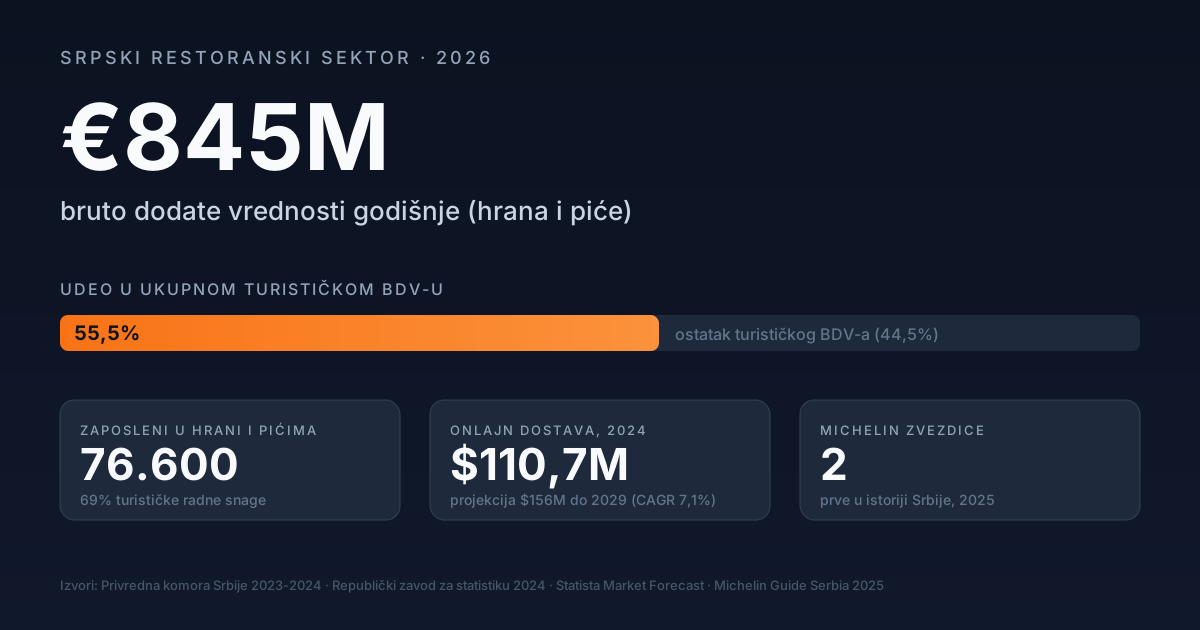
Serbia’s food and beverage sector generates €845 million in gross value added annually, accounting for 55.5% of total tourism GVA. Hospitality grew 8.3% in real terms during 2024, faster than overall Serbian GDP growth of 3.9% (RZS, Economic Trends 2024). Online food delivery reached $110.7 million in 2024, and Wolt has crossed 24 million orders since arriving in Serbia in 2019 (Statista Market Forecast; Wolt Newsroom Serbia, 2024). The figures below are drawn from the Statistical Office of the Republic of Serbia (RZS), the Chamber of Commerce of Serbia, Wolt Newsroom Serbia, the Michelin Guide, and roughly two dozen additional sources.
Key findings
- €845 million in gross value added annually, food and beverage, 55.5% of Serbia’s total tourism GVA (PKS, Tourism Association, 2023)
- Hospitality grew 8.3% in 2024, slowed to 1.5% in 2025 (RZS, Economic Trends 2024/2025)
- 76,600 workers directly employed in food and beverage, of 111,100 across all of tourism (PKS, 2024)
- 39,500 active business entities in tourism, including hospitality (PKS, 2024)
- Online delivery worth $110.7 million in 2024, projected growth to $156 million by 2029 at 7.1% CAGR (Statista Market Forecast, 2024)
- Wolt available in 32 Serbian cities, having crossed 24 million orders since 2019 (Wolt Newsroom Serbia, 2024)
- Wolt Market made up nearly a third of all Serbian orders in 2025, above the platform’s global average (Wolt Newsroom Serbia, January 2026)
- Foreign tourists visited Serbia 2.385 million times in 2024, growth of 12% (RZS, January 2025)
- Tourism brought Serbia €2.833 billion in foreign-currency revenue in 2024, growth of 11.4%, 19.6% of Serbia’s total services exports (NBS/PKS, 2024)
- Food prices fell 1.2% in March 2026, after spiking to about 8% annually mid-2025 (RZS, March 2026)
- Serbia received its first 2 Michelin stars in history (Michelin Guide Serbia 2025, October 2024)
- Belgrade records 25 Michelin selections in the 2026 guide, with 5 new entries (Michelin Guide Belgrade 2026)
1. Market size and economic contribution
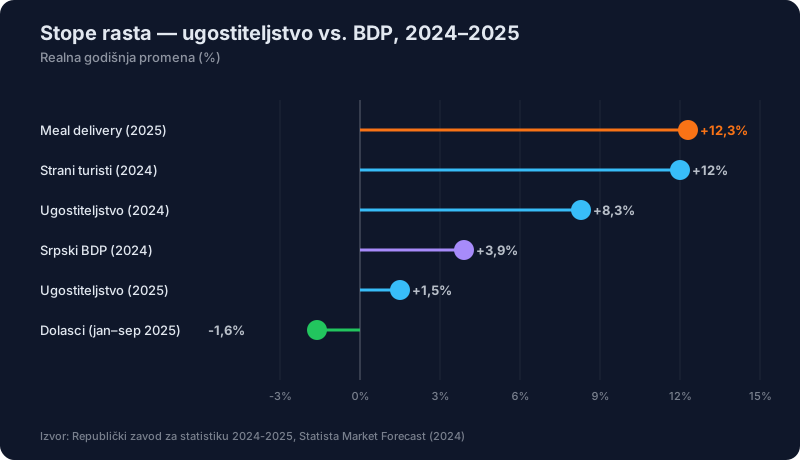
Food and beverage account for 55.5% of Serbia’s entire tourism GVA, which totals about €1.5 billion or 2% of GDP. The 8.3% growth in 2024 outpaced overall economic growth of 3.9%, and the slowdown to 1.5% in 2025 reflects the sector’s sensitivity to tourism volume drops and inflationary pressure on consumer spending.
Gross value added and share of tourism GVA
The Statistical Office and the Chamber of Commerce calculate tourism GVA as the sum of hospitality, accommodation, travel agencies, and supporting services. Food and beverage is by far the largest component: about €845 million out of ~€1.5 billion total. That’s 2.0% of Serbia’s entire GDP — individually small, but the sector with the highest number of active business entities outside retail.
Growth rate and the relationship to overall GDP
Hospitality turnover grew 8.3% in real terms during 2024 (RZS, Economic Trends 2024), more than double Serbia’s overall GDP growth of 3.9%. In 2025 the gap closed: hospitality slowed to +1.5% while overall GDP held around 3%. The sector tracks tourism swings closely, falling faster on a downturn and recovering faster when consumer spending picks up.
Active business entities and competition
The sector counts 39,500 active business entities in tourism, including hospitality (PKS, 2024), roughly one per 175 inhabitants. Independent kafanas, pizzerias, and cafes compete in a crowded field where brand recognition, online visibility, and delivery-platform presence matter more to a customer’s choice than price alone.
| Metric | Value | Source |
|---|---|---|
| Gross value added, food and beverage | ~€845M | PKS, 2023 |
| Food and beverage share of tourism GVA | 55.5% | PKS, 2023 |
| Total tourism GVA Serbia | ~€1.5B | PKS, 2023 |
| Tourism GVA as % of Serbia GDP | ~2.0% | PKS, 2023 |
| Active entities in tourism (incl. hospitality) | 39,500 | PKS, 2024 |
| Hospitality sector growth, 2024 | +8.3% (real) | RZS, Dec 2024 |
| Hospitality sector growth, 2025 | +1.5% (real) | RZS, Dec 2025 |
| Serbia GDP growth, 2024 | +3.9% | RZS, Dec 2024 |
Statistical Office of the Republic of Serbia, Economic Trends 2024
2. Online food delivery
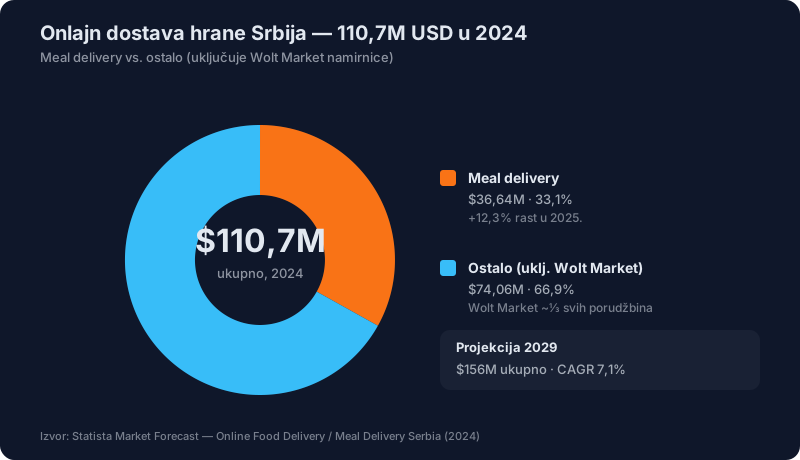
Online delivery reached $110.7 million in 2024 and is projected to hit $156 million by 2029 at a 7.1% annual CAGR. The meal delivery segment grew 12.3% in 2025, while Wolt Market (groceries, retail) took nearly a third of all Serbian orders, above the platform’s global average.
Total market size and CAGR projection
Statista Market Forecast splits Serbian online food delivery into two segments: meal delivery (cooked food from restaurants) and grocery delivery (Wolt Market and equivalents). 2024 total revenue: $110.7M. 2029 projection: $156M at a 7.1% CAGR. That rate outpaces overall Serbian GDP growth, placing online delivery among the faster-growing hospitality segments as restaurant foot traffic plateaus.
Wolt’s dominance and Wolt Market as a separate category
Wolt has crossed 24 million orders since arriving in Serbia in 2019 (Wolt Newsroom, 2024) and operates in 32 Serbian cities — more than any other delivery platform. In its 2025 annual review, Wolt Market (groceries + retail) takes nearly a third of all Serbian orders, above the platform’s global average. Sensor Tower Q2 2024 confirms Wolt is the #1 food delivery app in Serbia by downloads and unique users (Sensor Tower, Q2 2024).
What this means for a restaurant without its own channel
A restaurant operating only via delivery platforms pays a 25–35% commission per order and accumulates no guest contact data. Wolt and Glovo supply visibility, but the customer relationship stays on the platform. A restaurant’s own website with reservations, a menu listing, and a contact form returns that relationship to the owner. At 7.1% CAGR, platform dependence compounds year over year, so restaurants that build a parallel channel in 2026–2027 start from a stronger negotiating position than those that wait.
| Metric | Value | Source |
|---|---|---|
| Online delivery revenue, 2024 | $110.7M | Statista Market Forecast |
| Revenue projection, 2029 | $156M | Statista Market Forecast |
| Online delivery CAGR, 2024–2029 | 7.1% | Statista Market Forecast |
| Meal delivery revenue, 2024 | $36.64M | Statista Market Forecast |
| Meal delivery segment growth, 2025 | +12.3% | Statista Market Forecast |
| Total Wolt orders since 2019 | 24M+ | Wolt Newsroom Serbia, 2024 |
| Wolt cities in Serbia | 32 | Wolt, 2025 |
| Wolt Market share of orders, 2025 | ~1/3 of total | Wolt Newsroom Serbia, Jan 2026 |
Wolt Newsroom Serbia, annual review 2025
Restaurants that want digital visibility beyond delivery platforms can find ready solutions at Bezsajta.rs.
3. Employment and workforce
Of 111,100 workers in the tourism sector, 76,600 (about 69%) work directly in food and beverage. At a minimum wage of 79,797 RSD per month in 2026, labor costs remain below the EU average, though a ~40% minimum wage increase over the past three years pressures margins in a sector that runs on tight per-transaction profit.
Employment structure within tourism
Of 111,100 workers representing 4.8% of total Serbian employment, 76,600 (nearly 70%) work directly in food and beverage (PKS, 2024). The rest (accommodation, agencies, supporting services) splits less than a third of sector headcount. Restaurants and kafanas remain Serbia’s operational tourism economy; accommodation grows more slowly.
Wages and margins
Minimum wage for 2026 is 79,797 RSD per month (Minimum Wage Act, 2026). Average gross wage in Q1 2026 sits at 115,000–125,000 RSD (Trading Economics — Serbia Wages). Labor costs are below the EU average, but a ~40% minimum wage growth over the past 3 years pressures margins in a sector that operates on tight per-transaction profit.
Worker shortage as a structural risk
32.2% of hospitality companies report acute shortages of cooks and waiters (G-Hiring/PKS, 2024), one of the highest rates in the Serbian economy. A restaurant short-staffed during peak tourism season takes revenue and review-score hits together. Belgrade, Novi Sad, and Niš have responded by hiring workers from the Philippines, India, and Nepal in increasing numbers.
| Metric | Value | Source |
|---|---|---|
| Total employed in tourism | 111,100 (4.8% of total employment) | PKS, 2024 |
| Employed directly in food and beverage | 76,600 | PKS, 2024 |
| Food and beverage share of tourism employment | ~69% | PKS, 2024 |
| Minimum wage Serbia, 2026 | 79,797 RSD/month | Minimum Wage Act, 2026 |
| Average gross wage, Q1 2026 | ~115,000–125,000 RSD | NBS/Trading Economics |
Chamber of Commerce of Serbia, Tourism Association
4. Tourism and foreign guest demand
Serbia received 2.385 million foreign tourists in 2024, growth of 12% over 2023, with a total of 6.098 million overnight stays. Tourism foreign-currency revenue reached €2.833 billion, 19.6% of Serbia’s total services exports. In the first nine months of 2025, arrivals fell 1.6% and overnights fell 2.7%, partly due to internal circumstances that affected travel sentiment.
Arrivals and overnights
In 2024 Serbia received 2.385 million foreign tourists (+12% YoY) and 4.43 million total arrivals (RZS, January 2025). Overnight stays totaled 6.098 million (+9.2%), with guests staying longer, a positive signal for restaurants that serve repeat-visit rather than purely transient traffic. In the first nine months of 2025 the trend reversed: arrivals -1.6%, overnights -2.7%.
Tourism revenue and place in Serbian exports
Tourism foreign-currency revenue in 2024 reached €2.833 billion, up 11.4% and 19.6% of Serbia’s total services exports (NBS/PKS, 2024). Tourism ranks among Serbia’s top three services export categories alongside IT and transport. A restaurant in Belgrade or Novi Sad without EUR payment options and an English menu leaves foreign-guest spending on the table.
What a restaurant needs to prepare for the foreign guest
A foreign guest in Belgrade, Novi Sad, Niš, or Tara typically checks an English menu, books a reservation, and confirms the address on Google Maps before arriving. Restaurants missing those elements drop out of TripAdvisor and Google Travel results before the guest even makes a decision. The Bezsajta €59/month bundle covers all three: see what’s included.
| Metric | Value | Source |
|---|---|---|
| Foreign tourist arrivals, 2024 | 2.385M (+12%) | RZS, Jan 2025 |
| Total tourist arrivals, 2024 | 4.43M | RZS, Jan 2025 |
| Tourist overnights, 2024 | 6.098M (+9.2%) | RZS, Jan 2025 |
| Tourist arrivals Jan–Sep 2025 | 3.326M (-1.6%) | RZS, Sep 2025 |
| Tourist overnights Jan–Sep 2025 | 9.589M (-2.7%) | RZS, Sep 2025 |
| Tourism foreign-currency revenue, 2024 | €2.833B (+11.4%) | NBS/PKS, 2024 |
| Share of total services exports | 19.6% | NBS/PKS, 2024 |
RZS, Tourism Traffic, December 2024
For restaurants that want to attract guests who research the offering online before arriving, a website with a menu and contact details is a direct channel: Bezsajta.rs.
5. Prices and inflationary pressure
Food prices climbed as high as 8% annually in mid-2025, with spikes in fruit (+40%), coffee (+30%), and vegetables (+15%) cutting directly into margins. By the end of 2025, government price controls and supply-chain normalization reversed the trend: food prices fell 1.2% year-over-year in March 2026. General inflation slowed to 2.4% in January 2026, the lowest level in several years.
General inflation trajectory 2024-2026
General inflation (CPI) averaged 4.7% in 2024, fell to 3.8% in 2025, and reached 2.4% in January 2026, the lowest level in several years (NBS, 2026). Lower inflation supports consumer purchasing power, but restaurants that absorbed the 2024-2025 price shock cannot raise menu prices back to pre-inflation levels without losing transaction volume.
Food prices — from spike to drop
Food inflation peaked in mid-2025 around 8% annually, with specific shocks in fruit (+40%) and coffee (+30%). By late 2025 the trend reversed: food prices fell 1.0% annually in January 2026, and -1.2% in March 2026 (RZS, 2026). Government price controls and normalization of input costs drove the reversal; demand held steady throughout.
| Metric | Value | Source |
|---|---|---|
| General inflation, average 2024 | 4.7% | NBS, 2024 |
| General inflation, average 2025 | 3.8% | NBS, 2025 |
| General inflation, January 2026 | 2.4% | NBS, Jan 2026 |
| Food inflation, peak mid-2025 | ~8% (annual) | Erste Group/NBS, 2025 |
| Food price change, January 2026 | -1.0% (annual) | NBS, Jan 2026 |
| Food price change, March 2026 | -1.2% (annual) | RZS, March 2026 |
RZS, Hospitality Service Price Indices, January 2026
Restaurants reducing dependence on high-commission delivery platforms reach guests directly through their own website: Bezsajta.rs.
6. International recognition and quality
Serbia received its first two Michelin stars in history in 2025: Langouste in Belgrade and Fleur de Sel in Novi Slankamen. For 2026, Belgrade records 25 selections with 5 new entries, establishing the Serbian capital as a fine-dining destination with regional standing.
| Metric | Value | Source |
|---|---|---|
| Total Michelin selections Serbia, 2025 | 23 | Michelin Guide, Oct 2024 |
| Michelin stars Serbia, 2025 | 2 (Langouste, Fleur de Sel) | Michelin Guide, Oct 2024 |
| Michelin Bib Gourmand Serbia, 2025 | 1 | Michelin Guide, Oct 2024 |
| Total Michelin selections Belgrade, 2026 | 25 | Michelin Guide, 2026 |
| Michelin stars Belgrade, 2026 | 2 | Michelin Guide, 2026 |
| Michelin Bib Gourmand Belgrade, 2026 | 3 | Michelin Guide, 2026 |
| New Michelin selections Belgrade, 2026 | 5 | Michelin Guide, 2026 |
Numbers summary
| Metric | Value | Source |
|---|---|---|
| Gross value added, food and beverage | ~€845M | PKS, 2023 |
| Share of tourism GVA | 55.5% | PKS, 2023 |
| Tourism GVA as % of GDP | ~2.0% | PKS, 2023 |
| Active entities in tourism | 39,500 | PKS, 2024 |
| Hospitality sector growth, 2024 | +8.3% | RZS, Dec 2024 |
| Hospitality sector growth, 2025 | +1.5% | RZS, Dec 2025 |
| Serbia GDP growth, 2024 | +3.9% | RZS, Dec 2024 |
| Online delivery revenue, 2024 | $110.7M | Statista |
| Delivery revenue projection, 2029 | $156M | Statista |
| Online delivery CAGR, 2024–2029 | 7.1% | Statista |
| Wolt orders total since 2019 | 24M+ | Wolt Newsroom Serbia, 2024 |
| Wolt cities in Serbia | 32 | Wolt, 2025 |
| Employed in food and beverage | 76,600 | PKS, 2024 |
| Total employed in tourism | 111,100 | PKS, 2024 |
| Minimum wage, 2026 | 79,797 RSD/month | Minimum Wage Act |
| Foreign tourist arrivals, 2024 | 2.385M (+12%) | RZS, Jan 2025 |
| Tourist overnights, 2024 | 6.098M (+9.2%) | RZS, Jan 2025 |
| Tourism foreign-currency revenue, 2024 | €2.833B | NBS/PKS, 2024 |
| General inflation, January 2026 | 2.4% | NBS |
| Food price change, March 2026 | -1.2% | RZS |
| Michelin selections Serbia, 2025 | 23 | Michelin Guide |
| Michelin stars Serbia, 2025 | 2 | Michelin Guide |
| Michelin selections Belgrade, 2026 | 25 | Michelin Guide |
Methodology and sources
- Statistical Office of the Republic of Serbia (RZS), Economic Trends 2024
- Statistical Office of the Republic of Serbia (RZS), Economic Trends 2025
- Statistical Office of the Republic of Serbia (RZS), Tourism Traffic, December 2024
- Statistical Office of the Republic of Serbia (RZS), Tourism Traffic, September 2025
- Statistical Office of the Republic of Serbia (RZS), Hospitality Service Price Indices, January 2026
- Chamber of Commerce of Serbia (PKS), Tourism Association
- National Bank of Serbia (NBS), tourism foreign-currency revenue 2024, via SeeNews
- Wolt Newsroom Serbia, 10 years and 24 million orders, 2024
- Wolt Newsroom Serbia, annual review 2025
- Wolt Serbia, order analysis 2024 (NiraPress)
- Statista Market Forecast, Online Food Delivery Serbia
- Statista Market Forecast, Meal Delivery Serbia
- Michelin Guide Serbia 2025
- Michelin Guide Belgrade 2026
- Trading Economics, Serbia Food Inflation (based on RZS/NBS)
- Trading Economics, Serbia CPI Inflation
- Erste Group Research, Serbia Economy (cites NBS)
- Sensor Tower, Top Food Delivery Apps Serbia, Q2 2024
Last updated: April 2026. We update this page quarterly.